Exploration

Standard

20200611_165952

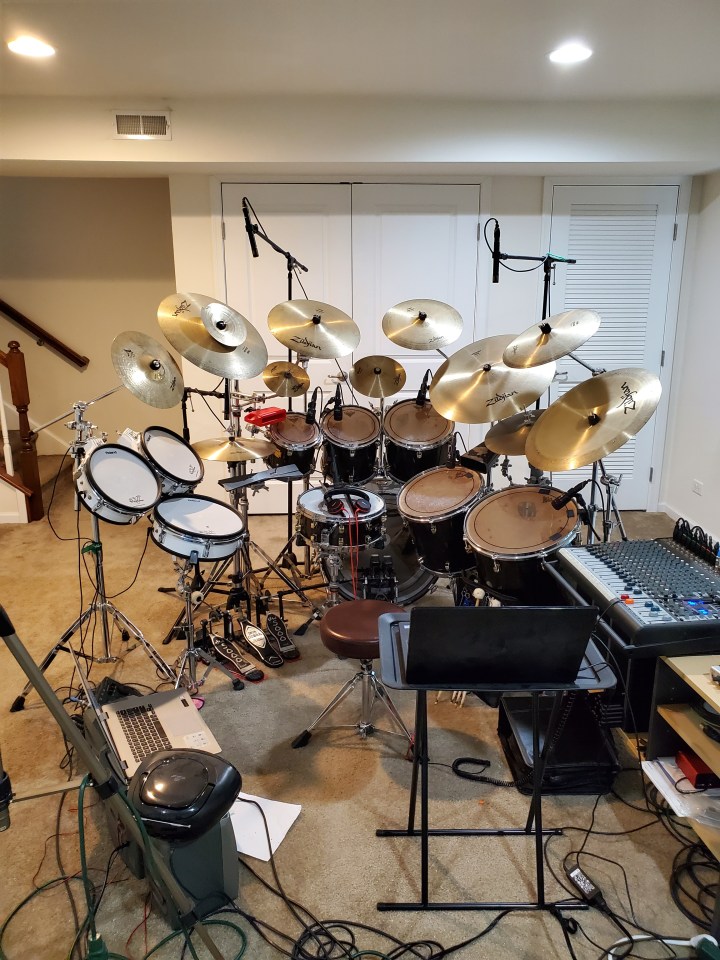
It’s been a while since I’ve written anything reflective and, at a time when so many things are challenging and in a place that makes them difficult to predict, it felt like maybe some words on something I love would provide much needed relief… my experience in performing music.

I’ve been playing the drums for over 40 years now, and one of the things that’s so amazing about music is how every time I sit down to play, the experience is different.  Certainly, in your early years and, over the time you learn to play, you spend time developing the technical facility to master basic drumming techniques (grips, rudiments), read music, learning different patterns and styles of music (jazz, rock, etc.), develop independence in what you can do within those styles, expose yourself to different types of players (professional and otherwise), rehearse and perform in small and larger groups, and explore concepts in how you improvise, whether as part of a song or entirely on your own.

Where music becomes interesting and fun is what comes after all that… when you have the ability to (largely) play what you want, when you want, and sitting down to play is more about expressing yourself and the music and experience you want to create.  This is what continues to inspire and amaze me and is probably why I love performing so much.  Every time I sit down to play, anything can happen, and the ability to create is solely dependent on my ability to be inspired and express myself in the moment.  It is very much like having a set of paints and an endless, continually unfurling canvas, and my ability to create whatever I can conceive of as it is all happening.

This is the primary reason that I try not to “rehearse” what I record today for YouTube and shoot for as many single take recordings as possible.  I want to evoke the experience of what it is to perform music live, where you don’t have a chance to “do it over”, you just have to put yourself out there, reach for the notes that express how you feel in that moment, and… if it doesn’t work out, you laugh it off, and move on.  In a way, it’s just like life.  We don’t get a chance to go back to undo things we wish we could have done differently.  We can always choose to play things safe and not make mistakes, but then we also will never experience the exhilaration that comes with creating something new and unexpected, that puts our personal touch into something that may otherwise seem commonplace, to express our voice in a way that may be new and refreshingly different.  Sometimes it’s something as simple (in the case of drumming) as a well placed accent, the feeling of a groove that is different than what the original artist played on an album, altering dynamics to express the emotion of a moment, and sometimes it’s a total flurry of notes, blasted out across the drums to convey the energy I feel in doing something I truly love to do… sharing music with others.

It can be difficult to convey what it is that is so special about music, especially for people who don’t have a passion for it, but what makes it so amazing to me is the ability to express oneself in a way that can be different every time you sit down, that can take you on a journey to somewhere you don’t expect, create a connection and an energy that wouldn’t otherwise exist for both you and the listener, and that can (for the set of people with whom you have the opportunity to perform) connect you in a creative experience that is very unlike anything else I know.

So, the next time you listen to a live performance, if you didn’t already, maybe take a moment to watch the performers, listen less to the notes and feel more of the experience… it is a moment in time that will never be created that same way again, and what a special and wonderful thing that is to experience when you have the chance to do so.

-CJG 06/14/2020

On Graduation Day

Standard

First of all, know that character, values, and integrity matter.  They are the foundation of who you are and the reputation you will have with others.  Our beliefs and intentions often make their way to our words and actions, so strive to do what’s right, treat others with respect, take accountability for your choices, and know that, in the long term, those who bring kindness and a positive attitude into the world will succeed far more than those who don’t.  They will also find themselves surrounded by many others, because a good heart and kindness are forces that will attract others to you over time.

Have faith, no matter what life brings.  There will be times when life is challenging and it’s important to know that we are never alone, that God (in all His forms) has a plan, and we will find our way through, as long as we take one day at a time and keeping moving forward.  There is a great quote from Winston Churchill, “When you’re going through Hell, keep going”, that I always remember in this regard.  Faith is our greatest source of hope… and with hope, anything can be possible.  With faith and hope, your possibilities in life will be limited only by your capacity to dream.

Work hard.  It’s a simple point, but one that isn’t evident to everyone at a time that many seem to feel entitled.  Earning your success is both an exercise in diligence and commitment as well as persistence and leadership.  Oftentimes that effort is not glamorous, requires sacrifice, and will drag you through difficulty, but in struggling and overcoming those obstacles, we find out who we are and the strength we have inside us.  No one can give that confidence and experience to you, you simply have to earn it, and it is well worth the effort over time.

Never stop learning.   There is always something to understand about other people, new ideas or subjects, and the world around us.  Always be looking for the people who can guide and advise you in the different aspects of your life.  You will never reach a point where there isn’t an opportunity to grow as a person, and it will make you so much more aware, fulfilled, and worth knowing as time goes on.

Believe in yourself and speak your truth.  In the great debate that life can be at times, you should know that your voice matters.  At a time when so many take a free pass and just parrot the words, ideology, or biases of others, you do yourself and the world a service to educate yourself, form your own opinion, and respectfully speak your truth, including the times you speak for those who are afraid to do so on their own.  Diversity in thought and opinion gives us strength and creates room for change.  Let your voice be heard.  You can make a difference.

Be humble and be kind.  In concert with the previous point, strive to listen as well as you speak.  Seek compassion and understanding, including those who differ most from you.  They have their own form of truth, and it can be worth learning what that is, whether you agree with it or not.  In a world consumed with egocentric thinking, what we do for others brings the world a little closer, creates the connections that bind us together, and reduces the divisiveness that so many waste their days promoting.

Never give up on your dreams but be ready to pursue new ones when you see them.  Life can be like a series of bridges, taking you from one part of your journey to the next, and we often can’t see past the bridge that is immediately in front of us.  While it takes tenacity and courage to pursue your life’s passion, understand that your goals will evolve as time progresses, and that’s not a bad thing.

Build upon your successes, learn from your failures.  Remember that it’s relatively easy to succeed when you’re not doing anything worth doing or that’s not particularly difficult.  Again, this is a relatively simple point, but it’s easy to lose the perspective that failures are a means to learn and become better, and they are definitely something that come with taking risks in life.  There is no benefit to beating yourself up endlessly over your mistakes.  Be thankful for the opportunity to learn and move forward, or likely life will give you the opportunity to learn that lesson again down the road.

Understand that true leaders emerge in adversity.  Aspire to be the light that can lead others out of darkness to a better place, whether that is in your personal or professional life.  It is easy to lead when everything is going well.  It is when things go wrong that poor leaders assign blame and make excuses, and strong leaders take the reins, solve problems, and seek to inspire.  It’s a choice that takes courage, but it’s worth remembering that it is also where character is built, reputations are made, and results are either accomplished or not.

Accept that life is rarely what we expect it to be.  It’s the journey, along with its peaks and valleys, that makes it so worthwhile.  Where possible, the best you can do for yourself and for others is to know when to set aside distractions, be present, and engage in the moments you have throughout your day.   Make the most of the experience and don’t be a passenger in your own life.

Finally, take the time to express your care for those who matter to you.  Life is unpredictable and you will never run out of love to give to others who are truly deserving of it.  We spend far too much time waiting for “the right moment” when that time could be right now.  Express your gratitude, express your love, express your support… both you and whomever is the recipient of those things will be better for it, and you will have an endless supply of those gifts available to give tomorrow as well, so no need to hold them in reserve.

I hope the words were helpful… all the best in the steps you take, in the choices you make, in finding happiness, and living the life of your dreams.

-CJG 05/27/2018

Finding Home

Standard

I recently settled into a new townhome, after several weeks of relatively stressful searching, in between trips out of town for work.

I moved to a smaller place, from a house that was, by any account, WAY too large for me.  The new place feels very cozy and oddly very comfortable despite being relatively unfamiliar.  I wonder why it is, though, that I feel a passing sadness at the place I called “home” for the last six years.

I didn’t choose this situation, the owner of the place I’d been renting encountered some hardship and needed to sell relatively quickly.  I didn’t have any idea and had done a number of other things under the assumption I’d renew my lease in July and leave that one piece of the larger puzzle of my life in place for another year or two.  Well… life has a way of being disruptive, as I’ve been reminded multiple times in the last couple years, and I guess I was resting in the wrong place for my sense of safety.

It’s funny how we associate so many things with the place we live.  Our memories… our hopes… our plans… it can be a sanctuary… our sense of a “home base”, even when we’re not there a lot… it’s an address that gives us a place in the universe that is uniquely and distinctly ours.

I came to my home after having six addresses in a period of three years.  I didn’t know what to expect, so I resisted the temptation to “settle in” for a really long time, assuming something bad might happen, as had been happening pretty frequently in the period of 2010/2011, and I might need to move on again.  Over six years, I hung exactly one picture of my girls on the wall.  No paintings, no new paint.  I was, in many ways, a tenant or a resident in someone else’s home… but it still came to represent a place I felt I belonged, during a period where there were times I didn’t seem to belong anywhere.

I was extremely lucky in where I landed, on a cul-de-sac surrounded by an incredible group of neighbors that I now consider friends.  Of all the places I’ve could have lived, I ended up in a place with probably the best sense of “community” of anywhere I’d been.  I didn’t leave with regrets.  I left feeling very blessed for the time I had.  I came out of a time of utter turmoil and heartache and found the thing I wanted more than anything else: a sense of peace.

I took walks nearly every day and became acquainted with an extended set of people, the vast majority of whom I never “met” beyond passing them on the path, and seeing them day after day.  I would say “hello” or “good morning” and observe the responses.  At first, most people wouldn’t say anything.  Over time, though, when you see the same people daily for months and ultimately years, it’s amazing how even the most silent person will eventually open up and return the greeting.  It was one of my favorite parts of my daily walks… the sense that maybe a little hello could bring the world just a little closer, at a time when people seem so disconnected and fearful overall.  One act of kindness, one nod, one smile to start a person’s day… some people eventually began to extend the discussion with me, starting the hellos farther away, so we’d have time to comment on the weather, how the other person was doing.  Such a simple thing, but such good energy to have in a day.  I would walk past the local CrossFit box, wave to John (the head trainer), get the wave back, notice some of the class react as well… odd how such a little thing can fill us up with a sense of connectedness.  I will need to start all over now, find a route to walk, meet a new set of random people, begin building the bridges all over again.  It will be fun to experience the evolution from the beginning once again.

At a broader level, I think that’s part of what makes moving difficult.  Even only having moved seven miles from my last place, it’s like I need to completely reset all of my understood norms.  Where I shop, where we eat… finding the best local pizza place, the best Chinese, Mexican… etc.  The good news is that I landed in an area with a LOT more selection close by than where I was before, and so it’s a relatively exciting opportunity to find something new.

And maybe that’s why, despite the sense of loss and sadness over having to move, I haven’t quite settled on how I feel.  I’ve had a very rough stretch of time, pretty much in every way you can, from late 2015 till now… and I’m tired.  That being said, I can see things have started to change, and it’s like I’m still somewhere in the middle.  We can never see to the other side of a bridge we haven’t crossed over yet, and maybe that’s why I’m uncertain about how to take all of this in.

Oddly, I’m hopeful and excited about what it could mean.  I needed a reset.  I allowed myself to become complacent and stagnate.  I enjoyed my “peace” too much, and that solace became a prison to my creativity.  Thankfully, a few experiences of the last couple years showed me I have way more energy and passion to bring into the world than what had been occurring.  I feel the start of something different, and that could be very explosively special, if I only have the courage to keep moving towards it and not stop too long to look back at where I was.

I need to look at the past as the set of things that made me stronger and wiser for what lays ahead, but not allow my desire to rewrite my own history to keep me from finding a better future.  Life is meant to be lived in every moment we are blessed to have… and right now, I’m moving forward.

I started this article with the simple desire to write about how I felt, given my recent move… and what it is to find “home”.  Ultimately, to me, our sense of “home” is rooted in the feeling in our heart that we are where we belong, doing what we are meant to do, at that point in time… put me in any hotel, apartment, or house you want… what I know today is that I need to focus on finding the fulfillment I’ve been seeking so long that I stopped looking for a while.  And that will start by being content with my circumstance, radiating out my capacity for love and joy to those around, and letting the universe respond in kind…  If I can have the courage to do that… then I’ve already found my new home…

-CJG 08/13/2017

Going Home to UIUC

Standard

Snapchat-939035628396555986

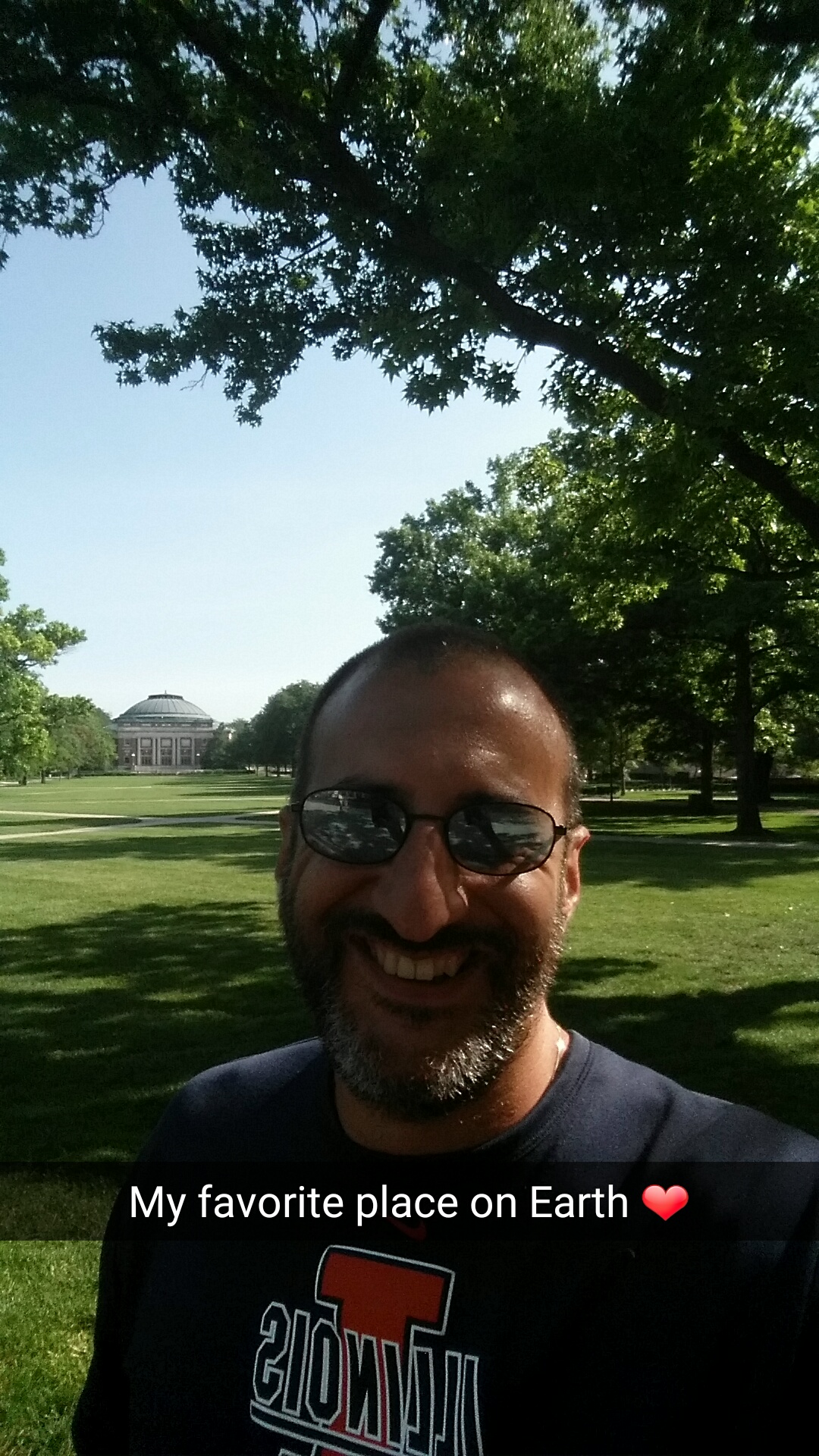
This day started as good as any day can… which is to say that I made reservations for our family to spend a weekend at my alma mater, the University of Illinois at Urbana-Champaign.  It is something we’ve done annually for a few years now, I’ve made some trips separately myself, and the simple reality of knowing it is coming is enough to make me feel incredibly excited.

I don’t know exactly why it is, but the minute I get off the highway, and start the drive down Neil Street and into campus, it’s like I’m in a completely different place mentally and the rest of the world is a million miles away.  The feeling of driving up to the Illini Union, walking out onto the Quad, seeing Foellinger, walking down to Memorial Stadium, seeing Assembly Hall (sorry State Farm), IMPE (ah-hem… the ARC these days) … it’s like time hasn’t passed and suddenly everything is right and at peace.  The air feels different and I can breathe.  There is no place like it on Earth to me, and I’m so glad to have it.

It’s an interesting experience to “go home” now.  It’s been twenty-five years since I graduated.  So much is different, but it feels the same.  Walking from one end of campus to the other, I’m reminded of so many experiences of being a student, while confronted with the inevitable change that is part of an ever-evolving landscape down there.  I remember performing with small groups and the jazz bands at the Nature’s Table and how we’d have to jam the big bands in there (to the point you’d have to climb over everyone to get back to the drums).  The Table was gone before we graduated, unfortunately, but the memories are still there… as they are for playing Treno’s which has been replaced by another restaurant off Goodwin, or the ice cream at Delights around the corner from there… my god… incredible.  Or the cookies from the Mrs Fields next to Kams off Sixth and Daniel… I don’t remember what they cost, it wasn’t cheap, but they were insanely good.  And there was Papa Dels off Green (not the main one down Green near Third), the one across from the EE building… pizza by the delicious slice for what seemed like a dollar.  I was never a “Garcia’s” guy, but even that is gone… I think replaced by a frozen yogurt place or something.   Of course, there is La Bamba and super burritos bigger than your head, but that’s a whole thing unto itself.  We were there nearly every Sunday, the one day of the week that the Newman Hall cafeteria wasn’t serving dinner… and that was just fine, especially when the “old man” was at the grill, smiling while he dumped so much salsa on your burrito that you knew your entire body would be on fire for the next 24 hours… so worth it.

The best thing I can say about the memories is how vivid and wonderful they are, so many years later.  The worst is probably how commercialized campus has become with chains of franchises like Potbelly’s, Noodles and Co, Jimmy John’s and so on.  They have the benefit of the familiar, but none of the character and personality of the little mom and pop places that used to make campus feel unique and different and special.  Maybe that shift is a good thing for the students today, because they’ve grown up with a world overloaded with homogenized ideas of everything being the same and they would feel more disoriented in a place where they can’t just expect consistency and a menu they know walking in the door… I personally feel they’re getting cheated out of what makes the experience different and those memories more special and unique to that time.  Maybe twenty-five years from now, these students will look back and say “oh yeah, I remember that time at Jimmy Johns” and it will still be somehow unique, but I wonder if it will have the same kind of meaning as it does for people who went to Champaign and remember La Bamba when it was in Candlelight Court by comparison with when they moved to the location closer to the Quad… no way to know really.

Not all my memories are significant because they originated in good things.  I remember the discussion I had with my good friend Mike Uchic outside the Music Building the night I heard my father had his heart attack, trying to figure out whether I should go to our Jazz Band gig or try to find a way to get home that night.  Mike asked me what my dad would’ve wanted me to do, I immediately knew he’d want me to play the job, to which he said, “then play this one for him.”  I remember it as probably the best gig I played the entire three years I was in the Jazz Bands, because of how much emotion came through in the performance.  In the morning and couple days after, I was further amazed by the support of both my friends and professors, who literally bent over backwards to make it possible for me to take the train back to Chicago, spend a couple days with him at the hospital, and get back to campus without missing a beat.  In case of my Physics class, the professor literally set up equipment in a lab and went to Loomis with me so I could perform an experiment I would have otherwise missed so I wouldn’t have to take a hit on my grade.  The University of Illinois is a big campus, but it felt very small and personal when I needed it to be, and I would never have expected that going in.

Coming back to Champaign, ultimately what made the time special, I suppose, wasn’t the locations so much as the people I met and the time we spent there… playing basketball, making music, going out, being stupid, and all the other things that make college life more than just the time you spend in a classroom, doing homework, and jamming through your finals.  The educational stuff was part of where I learned a ton and created many memories, for sure, but it was all the things about dorm life, music, recreation, and the people I met that made my experience in college so incredible.  As a pretty introverted person, I suppose the two things I’m the most grateful for are, first, that I pushed myself so far outside my comfort zone to reach out, meet a lot of new people, and by extension, make an amazing group of friends.  Beyond that, it was the tremendous luck that I had in where I lived in Newman Hall my first few years, the guys who happened to be situated on my wing and my floor, and the happenstance that it created in getting me involved with people who made the experience fun and wonderful and connected… starting with a lot of basketball at IMPE (sorry kids… the ARC), to late night games of Euchre (including the 2- and 3-man versions we would play as needed), to the times we ordered the Late Night Special from Pizza World… something like two 14-inch, two topping pizzas with four cokes for like $8 (as I recall).  Ridiculous…

As I said, a lot has changed.  Newman Hall itself has been massively renovated and is something like triple the size it used to be, but that main entrance and the old mail slots are still there… and those steps up from the front desk are just as uneven as they were over twenty years ago.  As luck would have it, in one of my first trips down to campus after a long hiatus, someone happened to be coming out of the building as I was walking by, I told him I used to live there (and pointed to my Sophomore triple that overlooked Armory), and he very graciously opened up the door, showed me around briefly, and let me explore the new building even though things were largely shut down for the summer…

Walking through the music buildings, the rooms where we had jazz band rehearsals in Smith and the Music building are still the same as they were then, as is the band room at the Harding Band building… and I still remember my freshman band audition, walking into that room for the first time, with all the percussion equipment on the floor in the front of the room, with fourteen directors and grad students sitting the audience seats, waiting for me to play the prepared and sight reading materials… holy crap in hindsight… but somehow I got through it and didn’t screw it up.  Thank goodness, because it led me to a year with the First Concert Band under the direction of Jim Hile, who ultimately became the head Director of Bands at the University of North Carolina the next year… something that made all the sense in the world, given how incredible a director he was.

Part of what I’ve come to appreciate since leaving Champaign is the larger community and family that I joined by simply being there… and that’s been a wonderful part of the experience as well.  While it can come down to a simple “ILL-” or “Go Illini” that someone says to me every once in a while on the walking path or the immediate sense of connection you feel with either current students or other alumni; it’s a wonderful feeling.  One story that I’ve told a few times as one of the stranger things to happen was about four years after I graduated and was doing consulting work at Kemper Insurance.  One day in the cafeteria, a guy came up to me and said, “Excuse me, but did you go to the U of I?”  “Yes.” “Did you play a lot of pickup basketball while you were there?”… by that point, I recognized the guy as someone else who played a lot at IMPE as well, and it seemed very surreal that something so seemingly small in my college experience (albeit we played 5 times a week at some points) would be something I’d be ‘remembered’ for…  at that moment, it felt like the boundaries of campus extended WAY beyond anything I’d imagined they could, and in hindsight it was probably one of my first experiences of how connected the alumni community is after I had left.

In any case, I suppose I could continue to write all day about the memories I have, and perhaps I’ll write more on it another time, but I started today with one of the best feelings in the world.. the simple notion that I’m going to spend a few days at the place that was my home for four years, where I met some of the best people I’ve ever known, and made memories that I will have forever… not always because of the good things, but because of the people and places that were part of the experience.  I’ve asked different people over the years whether, if they had the opportunity, they would make the same choices in terms of where they went to college.  Not everyone comes back with a resounding yes depending on their experience, but in my case, I wouldn’t do it any different, including the dumb stuff and bad choices that are part of how you learn where your limits and so on are…

I’m looking forward to seeing you again, Champaign-Urbana… and revisiting all the memories you hold… while we make a few new ones with my girls, in the hopes they have the same kind of experience when they head to college soon, wherever they may choose to go.

-CJG 06/10/2017 (BS, Computer Science – College of Engineering 1992)

20160625_151251

Lessons from the Classroom

Standard

chalkboard

Darkness cannot drive out darkness, only light can do that.  Hate cannot drive out hate, only love can do that. – Dr. Martin Luther King, Jr.

In thinking about telling this story, I wasn’t sure where to begin, but Dr. King’s quote seemed like a good place, because even though I haven’t known it for long, it has stuck and his message resonated strongly with me.  It both provides a concept and suggests a way to place our focus.  It signals a choice, in how we see and respond to things and, to that end, it’s as good a place to start as any.

Before jumping in, I should provide a little backdrop.  I believe there are moments that shape our lives, that influence our character, and that play a role in informing the person we will ultimately become.  I’ve participated in offsite meetings as a professional where, as part of the “ice breaker” and/or team building activity, people are asked to share a story about their life that has influenced them.  For me, this is one of those stories.  While it’s not a particularly significant one, it is something I have reflected on many times in the thirty plus years since it occurred.  That being said, as with any time I’ve written and shared my perspective, I’ll note that, while the underlying story is true to the best of my recollection, my point of view on it is merely that… my opinion.  Others could easily see the same thing from a different angle, disagree with any or all of my reactions, and be completely correct in doing so.  The goal of sharing this story was to take a moment to relate an experience and my reflections upon it in the hope that it stirs thinking for others in the choices we make, the words we use, and the impact those things can have… sometimes far beyond what we’d ever assume at the time.

As a student in middle school (“junior high” in my time), we had a teacher who had the phrase “Life is not fair” permanently displayed on her classroom wall.  My recollections of her, quote aside, were that she was a very unpleasant person, who seemed to have a scowl on her face a good percentage of the time, and who seemed to feel that pointing at her sign was a way to drive a point home with students that, whenever they didn’t like something, she had a ready-made, blanket excuse for why whatever she had just said or done was ok… because, after all, Life isn’t fair.  In truth, I didn’t know her particularly well, I had her for one class in seventh grade, and my focus the entire time was probably spent looking forward to the time when I’d be out of her classroom.

At one point during the school year, we had a “project” to hand in related to Greek mythology (not one of my favorite subjects).  For reasons I can only assume related to not really wanting to do it, I procrastinated until the last possible minute, but came up with what I thought was a relatively creative solution to the assignment, rushed to complete it, and handed it in.  My grade?  Zero.  No credit.  Nothing.  There was no partial credit, nothing to show that coming up with a solution and doing the work (albeit in a hurry) was any different than not having done the assignment at all.  Absolute, 100% failure.  To make matters worse, somehow as a result of the situation, my parents had to come to the school and meet with the teacher.  Whether that was initiated by the teacher, me saying something to my parents about feeling it was unfair, them responding… I honestly don’t remember at this point.  The point was that they had to go, and as the youngest of eight kids in an Italian family, one thing I can say without hesitation is that you never wanted to be in the situation where whatever you were doing was bad enough that our parents had to stop what they were doing and go to the school exclusively because you screwed up somehow.  Not a good thing, and the guilt and embarrassment of that alone was something that would have consequences to it for longer than whatever the actual event was.

In any case, the day came for my parents to attend the conference, and it is one of the few times (other than a band concert) when I remember my father actually going to the school along with my mom.  His participation generally meant something was a big deal, or he would’ve left my mom to deal with whatever it was.  Not surprisingly, that only would also add to the gravity of whatever it was and how it would play out at home, because if it was on my dad’s radar, it couldn’t be a good thing and had escalated beyond the ordinary-level issue.

I remember going into the classroom with my parents.  Thirty-three years later, I can’t honestly say that I remember exactly what was said, but I do remember a few things in particular.  First, how ashamed I felt that I was the subject of the discussion at all.  I had obviously failed or we wouldn’t have been there.  My parents expected better of us, and I had let them down.  Throughout the discussion, I couldn’t look at anyone and remember I just looked down, with tears in my eyes, feeling like a failure.  The second thing I remember was the teacher, telling my parents I was lazy, a poor student, that I wouldn’t ever accomplish anything, and that I simply ‘didn’t get it’.  The final thing I remember was my father’s reaction, which was to tell the teacher that I was a good kid… and if I didn’t get it, it was because she wasn’t doing her job as a teacher… to educate me.

In sharing the last part of this story, it’s important to note that my father wasn’t in ANY way soft on us with regard to his expectations growing up, especially in terms of accountability.  He was as black and white about right and wrong as anyone I’ve ever known in my life, and he could and would unload his form of discipline at a level that you understood when you screwed up without any shade of doubt being left in your mind.  That being said, there were moments like this where he felt one of his kids was being attacked, and he sprung into motion at a level it was very clear he wasn’t going to stand for it.  There are a few moments where I saw my father act like this in my life, and it was always clear to me that he had my back, and would walk through fire if it would keep me out of harm’s way.  It was just the nature of his character and how strongly he felt about protecting his family.  He always had a way of making us feel safe, even when he wasn’t immediately present, which is something I think all of his kids have struggled with since we lost him over twenty years ago.

Going back to the teacher and the situation, looking back on it today, it’s hard to equate to our current culture and environment.  Maybe our heightened sense of political correctness is part of the reason, but it’s difficult even now to understand what drove the words and behaviors of this woman, both in that moment and in how she approached her job as a professional educator overall.  What good could have resulted in calling me out in front of my parents at the level she did?  I really can’t imagine.  Certainly she didn’t anticipate the reaction she ultimately got from my father, because to the best of my memory, she was speechless in response to his comments.  In her defense, that was probably also the best course of action, because my father had a certainty in his voice whenever he’d argue that, even if he was dead wrong, you knew you would probably never win the argument, and he could be formidable in that regard.  It took a very confident person to ever argue with him, because he always approached situations with passion, conviction, and a strong belief he was right… and that could be a lot to take on.

At a personal level, one reason I know that I remember this experience was that it is one of only a few times in my years of schooling where a teacher suggested I would fail, and how strongly I feel about someone EVER offering that level of judgment on someone else.  She had no right nor any foresight to say that to me or to my parents and it was simply wrong.  To express concern and offer suggestions or assistance is one thing, but to attack someone’s potential, with all the possibilities that life can bring, is ridiculous and irresponsible.  Many years later, in completing my engineering degree, it was absolutely the case that I thought about her and the couple other teachers who said such things, and felt the strong desire to give them a call to give them the proverbial finger.  No one defines our character or our potential as human beings but ourselves, in the choices we make, in the effort we put forward when life challenges us, and in the way we engage with others on an ongoing basis… It is, however, frightening to think about how irresponsible some people are in what they say to others who are impressionable, the weight that can carry, and the negative consequences that can result, especially if the person receiving the information doesn’t handle it in the right way.  It’s true in more circumstances than just the classroom… and it’s a sad reality in life.  As an alternative, think about all the possibilities that would exist when the people tearing others down took the exact opposite approach and offered optimism and hope… if they built confidence instead.  What an amazing thing that could be.

In an overall sense, I’ve told my daughters about the teacher and her “Life is not fair” sign more than once before, because I have never fully understood what drove her to put it on the wall of her classroom in the first place.  She had so many choices for the message she could convey, and yet she chose that.  As a kid, it seemed like a built-in excuse to get smacked down by a teacher.  As an adult, it seems like the sign of a bitter person who is mad at life and who isn’t self-aware enough to realize that’s the message she’s projecting to a bunch of children every single day, every year that she is ‘educating’ them.

What if she had Dr. King’s words on the wall, something like “Be the change you want to see in the world”, or any one of so many other inspiring quotes?  If that was too optimistic, maybe something like “You are the sum total of the choices you make in life”, giving kids a point to reflect on in terms of how our decisions affect us over time.

The optimist would say that she taught me a valuable lesson through her ineffectiveness, which is that poor leadership can have a lasting effect well beyond what you’d expect, and that we learn more from our challenges and failures sometimes than our successes.  That being said, looking back, I feel sorry for her that she likely didn’t realize the negative impact she was having, through something she probably viewed as a mechanism to either maintain control in her classroom or “teach kids a lesson” on the harsh realities of life.  I’d like to believe she cared enough to not want that to be the case.  As an adult, it would’ve been interesting to sit down, talk to her, to understand what she was thinking in having that on the wall, and to try and offer her a different perspective on it.  Unfortunately, my memories of her are so negative and tainted, that I suspect she would’ve immediately checked out of the discussion, told me she was going to do what she was going to do, and it would be over with.  Some people can’t be reached and won’t change, and it’s sad, especially when putting words like that up for public display seems ultimately like a sign of an unhappy person to me.  I wonder how things could have been different had she tried to express a more hopeful and positive message.  Certainly it would’ve taken some of the constant negativity out of the line of sight of her students, but I wonder if it also wouldn’t have helped her just a little bit too…

So much of what we say and do, what we make a habit of, influences our thoughts and outlook.  Our viewpoint matters, whether it’s positive or negative, optimistic or pessimistic.  Whether we believe the universe is unfolding as it should, or is a perpetual manifestation of chaos…

In either case, as I said at the beginning, my goal in writing today was simply to share a story that influenced me and my reflections upon it.  Looking back, I suppose the experience is both about a person I remember as fundamentally negative and hostile, and how much I wish she saw the error in approaching her life (and all the students she influenced) in such a negative way, and about my father, and one of the moments when he reminded me that, no matter what I did, he would be there to protect and defend me… and how much I miss his strength and that sense of safety he managed to create when he was with us.

I hope this provided some food for thought.  We don’t need to be in a classroom for our words and actions to carry weight.  Our opportunity to make a positive difference is in the choices we make every day; in the way we relate and interact with others, in whether we want our message to be a positive and hopeful one, or something else… and those things matter in my opinion, sometimes far beyond what we consider at the time, and sometimes with a far greater impact than we’d ever expect, or I wouldn’t be writing about one of those experiences over thirty years after it happened.

I hope this was worth the time spent reading it…

-CJG 03/30/2017

Reflections on 2016

Standard

Where do I start?  I don’t know.  How about this?  I don’t have an end in mind.   I don’t have the answer.  I know about as much as this: I’m on a different path than where I was a year agoMuch different.  I don’t know where the road I’m on leads.  It’s unsettling and it’s exciting at the same time.  Hopefully that doesn’t sound fatalistic, it’s not meant to.

When we’re in our 20s, we’re pretty convinced we have all the answers and know everything…and maybe that’s a good thing, because we’re starting out as adults and trying to carve our path into the jungle of life, and it takes a somewhat fearless confidence to tackle the many things that are new and unexperienced in that period of time.  Today, it feels like I mostly have questions… I don’t expect the road to be straight, quite the opposite.  I don’t believe there’s a “destination” so much as periods of time in our lives and the transitions between them.  In thinking about this article, I wasn’t looking or expecting to share something profound or unique or necessarily insightful.  The goal was simply to relate some of the experience, both to share part of what I took out of this part of the journey, as well as to give myself a chance to reflect and try to find my own balance and peace with what occurred over the last 12 months.

In overall terms for 2016… It was a difficult year.  It was a great year.  It was discouraging.  It restored my hope and proved my faith.  It tested my patience to the limit.  It helped me become more patient.  It kicked my ass.  It made me a LOT stronger.  It challenged me.  It gave me perspective.  It was very unhealthy, yet I took my health and wellness to a level I never have before.  I jumped in.  I held back.  I leaned in and allowed myself to care.  I stepped back and walked away.  It was a study in duality… in contrasts… very significant ones.  It was wonderful.  It was agonizing.  I was at my center.  I was completely lost.  I saw people at their best.  I saw them at their worst.  I saw compassion.  I experienced callousness and apathy.  I kept others safe from harm.  I was in harm’s way.  I was proud.  I was ashamed.  I rejoiced.  I cried.  I struggled.  I overcame.

That’s a lot of contrasts to offer as a starting point… I understand that, but that was also the last year.  I can think of things that relate to everything in that list.  In most cases, many things.  Where they are unpleasant, that’s not something to feel very good about, but that’s just how things went.

It’s tempting to reflect on 2016 and say “we survived it”, but I don’t really feel like that’s the right message to summarize the experience.  It was an absolutely brutal year in terms of adversity, no question about it.  It was scary in every way it could be at times, and I characterized it as an “existential threat” at one point given how deep the hole I was in felt.  In retrospect, however, to acknowledge that also requires a nod to the reality that we overcame and survived the challenges we faced… and it’s something for which we have to be very thankful.  We walked on the edge of a razor, for a long time, but we also came out the other side relatively unscathed.  What we gave up, we can get back in time.  We retained the things we care the most about, and that means we were extremely successful despite the tradeoffs made.

Given that I don’t want this article to become unbearably long, I’ll focus on four aspects of 2016 that were significant and hopefully that will cover the “80%” that matters the most: Being healthy, Acting on beliefs, Making a professional transition, and Living an engaged life.  Perhaps some of this will resonate with others, maybe none of it will at all… it’s my experience and my perspective on it.  The nice thing about getting a little older is that I realize some of these impressions may be ones I see differently at some point in the future… our vantage point in life is so often determined by our present circumstance and environment and I don’t see it as revisionist history if we come back and see events in our life in a new light once we’ve move forward and take a second look.  Time can always provide perspective, when our goal is greater self-awareness and understanding.  Perhaps I’ll read this a year from today and see it all differently.  I don’t know… but hopefully I will have learned more getting to that point, and it won’t matter if I was completely wrong about something I’m saying today.

Being healthy

The simplest and best place to start is in terms of health for two reasons: it was entirely within my control and I did something fundamentally good for myself that made the year manageable.

In late 2015, through the inspiration of a fitness-minded friend, I started daily exercise that ran all the way through mid-November, where I completed 365 days of consecutive workouts, something I would’ve never thought possible.  I lost as much as 39 pounds at the lowest point, averaging somewhere around 35 for most of the last several months, and I got myself in the best shape I’ve been in, possibly in my entire life.  When I started, I didn’t think losing 25 pounds would be possible, I went way beyond that mark, and stayed there for a long duration.  There was also a period where I walked over 5 miles a day for roughly 90 days straight.  More than the workouts, I also significantly changed my diet, eliminating unhealthy foods, drinking pop, overeating, and generally got disciplined about everything.  I was also able to do so without compromising the foods that I enjoy, because the sustainability of what I was doing for my health was a paramount concern from day one.  I didn’t want to provide a short-term focus (albeit a year), do things I generally found unpleasant, and then slip right back into the wrong behaviors once I had completed the task.

So, there’s a difference between how I opened this part of the story versus what I just shared.  I didn’t start with why being healthy was important in terms of losing weight, getting stronger, or eliminating parts of an unhealthy diet, because those were the less important of the outcomes of what being healthy did for me in 2016.  Giving priority to my health gave me a sense of control and something to feel good about at a time when I otherwise felt out of control and sometimes very depressed about other things going on in my life.  I fundamentally believe that the reduced amount of stress I experienced, the optimism I felt, and the grounding I was somewhat able to maintain was a byproduct of the fact that I was taking care of myself.  It’s also worth noting that, over the course of the year of my workouts, I wasn’t sick once (save a few minor workout-related injuries, which is different), which is very unusual for me.  Had I not been exercising daily, taking those walks (where I always make time to pray and meditate), and focusing on my overall wellness, the challenges that came over the course of the year would have been a LOT more difficult to handle.  On my worst days, when I felt the most down, I used that frustration, sadness, and so on to motivate and drive myself to work out harder, to push myself a little more, and to tell myself that, no matter what else happened in a given day, I wasn’t going to compromise the things I could do to take care of myself.  It mattered and was one of the best things I did over the course of the year.

Heading into 2017, since completing the 365 day challenge, I’ve slipped off that level of consistency and moved back to the 25 pound line, which is certainly better than where I had originally been, but isn’t something with which I’m satisfied.  What I learned is how important being healthy is.  What I want to do in 2017 is figure out an approach that gives me a little more flexibility and variety, while still keeping me in a good state of wellness overall (physically and mentally).  Doing the same thing I did for a year feels like a “last year” thing now, and so I want to move forward and try something new… what that is, I don’t know, but I have a few ideas and it’s a matter of getting focused and started.  The clock is ticking and I know the amount of change ahead of me will require me to be on top of my health again… no question about it.

Acting on beliefs

With regard to this topic, I’ll share two statements about character that I remember from high school:
–          “If you don’t stand for something, you’ll stand for anything” – and –
–          “The highest compliment you can be paid is to be said to have the courage of your convictions

In both cases, the words resonated with me in terms of having beliefs and standing behind them, which is probably why they have stayed with me for roughly thirty years since.

Beyond that, these are some fundamental beliefs I have:

I believe our character is tested and shows up when times are challenging.  It’s easy in my experience for anyone to look good when conditions are favorable, but the strong among us tend to emerge when things aren’t going well.  They are the people who step in and engage, who seek to make a difference.  That may not always be in a positive way, I should add, but the point is that the average crowd seems to include a lot of spectators and very few capable speakers.  Adversity is the litmus test for character.  Some are eager to deny their individual role and accountability, assign blame for the conditions to someone else, or step aside and leave problem solving to others.  In the case of the passive observer, my opinion is that they can do harm or good, depending on who is actually at the proverbial microphone, leading the discourse at such times.  If the prevailing direction isn’t a good one, it’s important to have people willing to stand up, raise a hand, and ask questions to avoid things heading in a worse direction from where they may be.  It takes courage and a willingness to go against the grain, which is difficult.  This is why character is so important.  We are defined in those moments: what we choose to do, what we choose to say, how we choose to engage… all of which fundamentally involve choice.

I believe we are defined by our actions, not our words. Again, I’ve known many people who talk a great game and can say all the right things, both personally and professionally, but then are nowhere to be found when leadership and action are needed or, worse yet, who act in direct contradiction of the words they maintain as their somewhat crafted and marketed public persona.  The latter of the two honestly disgusts me, and there’s no real way to make that sound pleasant because of the next point I’ll make on integrity.  If I had to choose between people who talk about doing the right thing, but do nothing when the opportunity presents itself and those who actually do harm while suggesting they are doing good… it’s not really even a contest.  That being said, I’ve also been blessed to meet and know people who do step in and take action in defense and service of others or of the greater good in difficult times.  People who say what needs to be said, do what needs to be done, who throw themselves into the fray and accept the consequences of their choices, and choose to be a part of the solution.  I have always been an action-oriented person, and I suppose that’s why I’ve always had such a high degree of respect for people I see as participants versus spectators or combatants.  Consequently, it’s taken a lot of time and focus to try and improve my ability to deal effectively with people I see in the latter category, because almost inevitably, my sense of values and commitment to doing the right thing will tend to cause friction with people I see as putting others in harm’s way.

The reality is that the world we live in has threats, but not everything warrants intervention, and picking battles is something I’ve spent a lot of time trying to be more deliberate about, because despite the fact that I am not conflict avoidant, I hate conflict.  That is a difficult concept for some who know me to understand, because I will jump into the fray as and when I believe necessary, but I find the discord and strife very unsettling, and I generally don’t want to be a part of it.  I’d prefer that people just get along and not have to participate in the conflict at all… the problem is that someone needs to be willing to stand up for what they believe is right or take up the defense of others, and I believe those are fights worth fighting.

I believe integrity matters and it defines us.  I’d love to be able to say I’ve always been 100% honest.  I haven’t.  That being said, I’ve also been burned by the mistakes I’ve made badly enough and enough times that I have a very difficult time not being 100% honest today.  That said, there’s a big difference between being honest and being “right”, and I understand that distinction.  To me, having integrity is largely about being true to our beliefs, meaning what we say, saying what we mean, and standing behind those words, regardless of the audience.  If we can say something in one conversation, that version of our “truth” shouldn’t be any different when a different audience is present.  Speaking our truth, though, shouldn’t get in the way of being receptive and open to other points of view and being willing to acknowledge when we are wrong, and there is a significant amount of integrity to be found there as well.  Yes, it can take strength to present one’s views honestly in a difficult situation, but it can take even more courage at times to admit when you’re wrong… and that’s not always easy when the stakes are high.  The best thing I can say about being transparent and having high standards in terms of integrity is that it actually makes life a lot easier.  Maintaining alternate forms of truth seems pretty complex, time consuming, and stressful from my perspective, and it’s amazing how easy it is to answer questions and discuss things as many times as may be required when you’ve never “made something up” in the process.

Finally, I believe we shouldn’t be measured by what we have, but what we give, and what we do in service of others. It could be that this is a matter of mental self-preservation right now, given the challenges that came with losing my job in 2016, but ultimately I leaned in and invested in helping others despite the significant challenges we faced.  I don’t regret those choices, they are part of what I feel the best about, but they came with their own form of stress at times.  The time it will also take to dig out from the impact of those decisions could be material as things stand, but it served as a reminder of the importance we place on ourselves versus those we care about.  Arguably, I need to do a better job thinking through where those boundaries are heading into the new year, because I probably sacrificed more than I should have and at some point I need to make sure I don’t get crushed under the weight of what I give.

In any case, one of the things I feel good about coming out of 2016 was the things I did to help other people.  Conversely, heading into 2017, my inability to do the same at the level I previously have (given those investments) is somewhat frustrating right now, but who knows what may change in time as the year progresses.

Overall, I doubt that many would disagree with the beliefs I’ve expressed as good ones to have.  The question is really about living into them, and to that extent, I feel very good about the choices I made in 2016.  We can’t influence or control how others respond to our truth, our kindness, or our charity at times, but it doesn’t make the intention or the effort any less significant, and that’s something I continue to remind myself when necessary.

Making a professional transition

It’s tempting to focus on the journey of losing and finding a job, but that’s not really the goal of reflecting on the job transition that came in 2016.  I wrote a separate article on the learnings from the search experience already and hopefully that will prove helpful to others somehow.

What made 2016 significant in terms of job transition was the realization of the risk of allowing myself to stagnate professionally.  While I learned a great deal over the five and a half years of my job, I also became very complacent about the lack of challenge, ability to grow and learn, and unpleasant parts of the environment itself.  It was an interesting part of my search process to have a number of people ask me how I lasted so long doing what I was doing.  As much as that sounds like an insult to the organization, it really is a critique of the fact that I didn’t take an active enough role in looking for something different and something better, that would give me a larger sense of professional participation, engagement, and growth.  That’s 100% on me, and it was a major revelation of 2016.  I can’t be a passenger in my own career, and I settled for way too long for something I didn’t enjoy doing.  Moving forward, I need to do a much better job being open and aware of the possibilities to continue to learn and develop, whether within my current environment or in a new one.  I’ve never been a person who moved from company to company, and I don’t expect that to change.  I do, however, have an increased awareness of the reality of the concept of “at will” employment, and I paid the price of being largely unprepared for the reactive and somewhat morally questionable decisions that led to a major impact on me and a lot of other unsuspecting people in the middle of 2016.

Aside from general awareness, one other thing that I realized early in the year through an opportunity where I was deeply engaged in the interviewing process, was the passion I had for trying to engage at a different level in my work and truly drive significant results.  While I’ve always been very committed and results-oriented, I think the lack of emotional investment that I had for a number of years built up into a lot of untapped energy that I’ve yet to expend.  How and when that will come out, I’m really not sure, but there was a time early in 2016, with a specific opportunity, where I had the first real “let’s go do this!” level feeling I’ve had in a long time… and I hope that I can find that resonance either in what I’m now doing, or in whatever comes down the road.  That alignment of personal goals and organizational opportunity was there for a brief period of time, and while that specific position didn’t work out, it was a powerful experience in terms of my desire to push myself much harder than perhaps I have in some time.  Conversely, having that feeling and sense of possibility, and then not having it come to fruition was probably one of the largest disappointments of the year overall.  Not because it had any direct, real impact to me or my family, but because I felt the impact of the loss of possibility… I had allowed myself to envision what could be possible if that opportunity came to be, along with a set of other life changes that I was considering (at the time) as a result.  The first domino falling was meant to set off others, and unfortunately, it fell in the wrong direction, leaving a lot of other things I had considered as positive steps standing and stuck right where they were.  Considering that my job then went in the wrong direction only a few months later, it was a compounded impact that has been difficult to overcome, but hopefully will subside and be replaced with a new vision as 2017 gets into motion.

Living an engaged life

This final point is honestly more about 2017 in the sense of action, but the realization for the need to change did come over the course of 2016.

I was very blessed during the course of the year to be inspired to change; to revisit what I’ve been doing, how I’ve been thinking, how I’ve been living, how my passion hadn’t really been leveraged in the right ways… a lot of things that come to living life to the fullest.  I was and probably still am… falling short.  That isn’t to say I don’t have a full life, or a million things going on, or things to feel good about, or anything like that.  The point is whether I was sitting back and being a passenger or leaning forward and being the driver enough of the time.

One of the things I came to realize over course of the year was that I allowed myself to slip into too much of a passive and risk-averse position, for many reasons.  The point, however, is that I’ve wanted that to change, and through a combination of choice and circumstance, I started coming around that corner through the course of the year.  While I’m not suggesting that we can or should control life, which is not possible, I want to find a way to enjoy the ride and explore the side roads a little more than perhaps I have been for the last few years (at a minimum).  All the reasons that I decided to choose peace and stability for a period of time were reasonable and arguably necessary coming out of some difficult experiences several years ago, but I believe that time period has ended and a new one is here… the question is really taking the first steps out onto the new road and seeing where it will lead, accepting the challenge it represents, but looking for the opportunities to enjoy the experience along the way.

Summing it all up, as I said at the opening, 2016 was a year of significant contrasts and a year of major change… I could see it for the obstacles and adversity, but I’m trying very much to see it for what I learned and what it did to make me stronger and give me new perspective heading into a new year.  Whether I’ll be able to say something similar at the end of 2017, I have no idea… but I certainly expect I’ll see and experience things I haven’t before, and maybe that’s exactly what I’ve needed for some time.

So, thank you 2016.  I’m really glad you’re over.  I’m looking forward to seeing what I can do to make 2017 put you to shame… but if all you did was teach me I am strong and I can survive adversity, you did your job well… and I’ll probably come back and thank you for it later.  In the meantime, I have work to do…

-CJG 01/02/2017

Reflections on the Job Search

Standard

needle-in-a-haystack-380

Having recently completed what felt like a very arduous job search, I’ve been wrestling with the idea of writing this article for a while.  Certainly, there have been many things written about the dos and don’ts of a job search, of interviewing, and most of it probably wonderful and helpful.  Honestly, I’ve read some of it, but that’s not really the purpose here.

I’ll state up front that nothing herein contained may be unique, novel, etc.  There are a lot more educated and informed people than me on this topic, and I’d certainly suggest that anyone heading into a search do as much homework as they deem appropriate to their needs.  In my case, I did some, but not a lot of it.  I don’t tend to do much “research” when leaning into something unless I’m really uncomfortable with the subject.  I generally want to jump in and navigate a situation based on what I see that is working and what isn’t.  It’s not an approach that works for everyone, so I’m just going to acknowledge that up front and allow whomever takes the time to read this to decide whether some of the points are helpful or not.  They are ultimately my experience of and observations on what happened in my case.  Is there general applicability?  I actually believe some of this could be quite helpful to others going through the process, which is partially my goal: to aid in that effort.  The other primary goal is to get the experience down in writing and help myself move forward.

Fundamentally, writing is a cathartic process for me, but it also serves as a means to help organize my thoughts, reflect, and try to determine what I’ve learned from my experiences.  In this case, the search process itself was extremely stressful and challenging, as I expect it would be for anyone heading into or experiencing it today, and looking back on what occurred is at least a minor attempt at trying to glean out the things that I would apply should I find myself in the situation again.  A professional career is a long-term thing and, as such, it’s incumbent upon all of us to find ways to improve and be better at everything surrounding it, including periods of change.

In any case, I wanted to open with an acknowledgement of the reason behind writing this, as well as the understanding that there are a lot smarter people than me who have written on the topic.  The goal here is simply to relate my experience and observations.  To the extent it can help others, I certainly hope it does.  Searching for a job can be an extremely stressful and challenging experience.  If something here helps take even one day out of that process for someone else, the effort in writing it will have been worthwhile, and I sincerely hope that will be the case.

The remainder of this article will be focused on five aspects of my job search: the overall context, the “searching”, the interviewing, observations on the search process, and the emotional side of the search.

The Overall Context

First of all, I was lucky in my search process and, given I was looking as an experienced hire, the fact that it took a little over fifteen weeks was a very favorable outcome.  That is true both because I was thrust into the process with no warning and no financial relief and I ultimately ended up with a better position than the one I left behind.  I also had three viable career options at the end of the search, which helped reduce the risk and stress I would have otherwise encountered had I been dependent on a single choice.

At an overall level, certainly one thing that I took out of the process was that maintaining an active professional network is something everyone should do, because things like this can and do happen, and being as unprepared as I was certainly added time and some lag to the front end of the process.  While I had explored some options prior to being hit by an unexpected reduction in force, I simply wasn’t ready to be engaged in a time-critical, full time search and I wish I had done a better job staying connected and being aware of what was going on across my network while I was working, not necessarily because I would’ve been looking to leave my job, but because the time it took to get caught up could’ve been avoided had I just been a little more conscious of staying connected with people along the way.

A second point at an overall level is that I was also very lucky because I had a safety net in place that provided the time needed to complete the search and helped our family avoid what could have been much more severe consequences.  Certainly, the old adage to “hope for the best, but prepare for the worst” is something I’d also recommend to everyone in terms of my experience.  I know there is a lot written about setting aside X months of salary just in case of a job loss.  I never really gave that much thought until this situation occurred and, while there are practical limitations in terms of what any of us can reasonably set aside for a rainy day, we were very lucky that we had the means to carry us through the period of time required.  Other people who had been impacted by the same event may not have been as fortunate, and I certainly hope and pray that they were either able to find something quickly or to find a way to carry themselves through as well.

Third, it’s important to understand that you won’t finish what you don’t start in terms of a search.  I will write some specific observations on the search process itself separately, but the overall point is that the hiring process will take time, no matter what you do, and even in the best of scenarios, it will take more than a month at almost any company, and more likely two or more from my experience.  Certainly there can be exceptions to that statement, but the hiring process moves at a pace that is independent to the urgency of a candidate.  It moves at a pace that is driven on the needs of the company filling the position and, insofar as my search was concerned, that was generally not very fast.

Given the previous point, since even a successful interviewing process will take a possibly material amount of time, if there is time-sensitivity involved in a search, a priority in starting a time-critical search needs to be surfacing as many opportunities as possible, as quickly as possible.  In cases where someone has a reasonable financial cushion that allows for a more deliberate and drawn out process, this may not be as important, but when time is a factor, certainly a candidate needs to get as many lines in the water as possible quickly, so the process of establishing and exploring leads can begin.  In my case, the job that I ultimately secured came into the process as of the sixth week of my search and took nine weeks to complete.  While there is no way to evaluate whether making that connection earlier would’ve resulted in a shorter search, there also wasn’t any physical barrier to having gotten started, so it is entirely possible that I wasted time (and money) by not exploring that avenue sooner.  This was actually true for two of the three companies that were in active consideration at the end of my search, so in hindsight, I wish I had done a better job at this early on.

In stating the previous point, while I will touch on the emotional side of the process separately and it may be obvious that surfacing opportunities is important, the issue in executing it effectively has little to do with the pragmatic side of a search.  Generally speaking, there are two things that almost anyone will experience on the front end of a search: the disappointment and shock of being impacted in their current position and the somewhat overwhelming prospect of conducting a job search while unemployed, especially if the person didn’t have one going at the time they were impacted.  The combination of these two things makes getting started in earnest very difficult for most people in my experience, and there is a very careful balance to be struck in allowing oneself to heal and recover from having been through an adverse impact situation and also getting focused on moving forward effectively.  Ultimately, the best I can say is that tenacity and persistence matter.  Some days just won’t be productive, others will.  The trick is to make the most of the days that are productive ones and to try and find ways to make some level of progress on even the days where focus and positive momentum isn’t easy to maintain.

As a final overall point, I fundamentally believe that beginning with the end in mind is important.  It has often been said that it is far better to be running towards something than running away from something else.  The statement is very true when it comes to a search.  Again, in my case, I was very fortunate that things worked out as they did, but I also was conscious of trying to make sure that I was only pursuing opportunities that I had an actual interest in taking on as my next job.  I did not apply to every position I saw on the internet, especially when I felt I didn’t match up well to the stated position requirements.  I also did not apply to companies that would traditionally hire from my previous employer, largely because I wanted a change and they were involved in the same kind of business.  I also did not actively pursue jobs where the travel expectations were significant, because the time I have to spend with my family is very important to my work/life balance.  Arguably, not everyone will look at things this way and circumstances may necessitate a higher level of compromise depending on the situation.  Said differently though, at one level, I believe it’s relatively easy to find an undesirable job, the trick is to find one that you actually want to have.  In a ‘perfect world’, I’d certainly suggest that thinking through the next job and its ‘desirability’ is important so a candidate doesn’t waste time pursuing things that aren’t really aligned with their longer-term career goals.  Realistically speaking, if a candidate ends up securing a position they also don’t have an interest in, they will have solved the issue of being employed, but find themselves immediately back in a search or possibly an unsustainable job situation, neither of which is a good outcome.  Again, circumstances can and do have an impact of finding the ‘perfect job’, but a person can also only reasonably skip from one job to another to a limited degree over time before it will start to have an adverse impact on their future opportunities.

The “Searching”

Shifting focus to the search process itself, the first, primary point I would make, especially as an experienced hire is the obvious one… network, network, and network.  Ultimately, of the more than fifty companies/recruiters that I engaged through my search process, seven of those contacts led to opportunities with some level of active, deeper discussion.  Four of those seven opportunities (and two of the final three) came from networking with people with whom I’d previously worked, three of whom I contacted via LinkedIn messaging.  Two of the remaining three (one of which was in the final three) were contacts from executive recruiters who found my profile on LinkedIn and contacted me proactively.  The final opportunity of the seven was a position that I found on LinkedIn’s job postings to which I applied directly, although I had no connections in the company at all.  In that case, the lack of an internal advocate ultimately likely caused me to fall out of consideration as I was highly exposed to the individual impressions of the interviewers, which can be difficult to predict overall (something I’ll address in the interviewing section).

The single most valuable tool in my job search was, without any hesitation, LinkedIn.  It was useful in terms of surfacing opportunities through my network (ultimately including the position that I secured), in applying for positions (I upgraded my account to Premium for the purposes of leveraging the additional job search capabilities), and in putting my best foot forward in the interviewing process (i.e., a significant number of interviewers looked at my profile on LinkedIn in advance of conducting my interview).  Having a LinkedIn profile that is updated, contains the relevant keywords, skills, endorsements, and so forth can only help a job search, both ongoing and in creating visibility that can lead to future opportunities.  I can’t underscore this point enough.

In terms of other tools, I joined a couple executive search sites (Execunet and BlueSteps) and didn’t find anything useful from either site.  Everything on Execunet I could find through another aggregation site (like Indeed.com) and BlueSteps, while likely helpful for retained search firms to access a larger repository of candidates, did nothing to help surface any leads for me in the search process. Given there is cost associated with accessing the capabilities of these sites, I was very disappointed in the lack of utility in both.  In reaching out directly to larger executive search firms, I was again reminded of the importance of networking, because the follow up from all of the eight organizations I contacted (where I didn’t have a personal connection) was non-existent.  It’s entirely possible that one or more of these companies could have helped in my search process, but my lack of a direct connection into them all but torpedoed my effort to leverage them effectively.  Ultimately, the process that worked the best for me was to use LinkedIn as the point of origin for my overall search and extend to other sites from there.  From a process standpoint, I reviewed all of my contacts on LinkedIn individually, looking at where they were working, visited those company websites, and I took one of two paths.  If there was a position, I would reach out to my contact to see if I could obtain help in the application process, minimally to list the person as a reference to try and reduce the risk of being eliminated in the HR review step.  If there was not a position listed and I either had a strong relationship with the individual or liked what I saw about their current company, I would send them a message on LinkedIn to ask if there were any opportunities.  Ultimately, this latter approach is what led to the position I eventually secured, because there was no position listed for the job I am filling.  It came entirely as a byproduct of reaching out to a friend from a previous employer.  The other approach I used with LinkedIn was to continually review the postings available on the site itself and either post directly to positions I found there (one of which turned into a relatively well qualified opportunity) or use the postings as a means to identify companies that matched up with the smaller to mid-size organization that I ultimately wanted to pursue.  Again, the utility of the site was well beyond anything else I leveraged in the search process and notwithstanding a better platform surfacing in the coming years, it would definitely be the starting point I’d use for any future search.

As a final point on networking, for people early in their career, they won’t have as much direct professional experience to draw from, so likely the best thing to do would be to lean on experienced people with whom there is a strong personal relationship and see whether that can help reduce the barriers that will otherwise exist in the process.  On the experienced hire side, I’d simply say that I felt sending a resume anywhere where I didn’t already have a connection was 80-90% likely to be a waste of time.  In practice, after a point, senior positions require such a depth and breadth of capabilities that relying solely on a resume and/or cover letter to break through the initial barriers in the process is nearly impossible.  This isn’t to say that it can’t be done, but my experience was that having confidence in a job pursuit is directly related to whether you know someone in the target organization already and the strength of the relationship you have with that individual.

The Interviewing

At an overall level, the things that I believe matter in terms of job satisfaction are: the work you do, the person you work for, the people you work with (internal and external), the level of travel involved, the compensation associated with the position, ability to maintain work/life balance, and the culture of the company as a whole.  In my experience, if you can find four or more things in a given job, the opportunity will probably work out reasonably well (assuming there isn’t one factor that materially outweighs everything else, like being significantly undercompensated).  In the event, however, that more of the above factors are not in your favor, there will likely be significant problems somewhere in maintaining satisfaction with the job.  As a result, this is the set of dimensions at which I am generally looking during the interviewing process.

Beyond the overall search criteria, the first observation I’d make on the interviewing process is related to preparedness.  While it is common sense to be prepared for interviews, it doesn’t hurt to reiterate the importance of thinking through a few things relative to making the most of the opportunity.  In my experience, many people asked me for a short overview on my career, what I was looking for in the next opportunity, what was good or bad about my last job, why I changed jobs in the past, and what I found interesting or exciting about the specific opportunity we were discussing.  I certainly got much better at answering these questions the farther I got into my search, but the experience drove home the importance of thinking through the messaging you want to come through in the process, because it should reflect your priorities, values, and ideology overall.  Thinking through some of the general behavioral interview questions (e.g., times when you have overcome adversity, addressed complex business problems, managed difficult client situations) is also worthwhile.  This is an area where I could have done a better job early in the search, because having twenty-five years and five jobs worth of experience to draw from was almost overwhelming in terms of trying to pick the best example in line with a particular question from an interviewer.  At one point, I realized I was trying to think through the behavioral interview questions too much on the fly and so I spent a small amount of time reflecting on each of my jobs and trying to think about what major examples might be good discuss from each.  That exercise is one that I realistically should have done as soon as I started the process.

In terms of the questions I asked the prospective employers, I generally asked two things of everyone I met at a minimum: what they liked the most and the one thing they would change about their company, and the same question in relation to their company’s culture.  In most cases, the response on things people would change dealt with a functional aspect of their job: workload, travel, more operating efficiency, access to the right expertise across the organization, but culture rarely came up.  When asking about culture, however, sometimes the answers were more concerning in terms of a potential workplace than the operational things people mentioned on the first question, while in others, the positive cultural aspects of the workplace that came through made a prospective employer much more attractive, regardless of the day-to-day issues the individual otherwise had just described.

As a final point on interviewing, I was very surprised but reminded of the importance of brand and reputation in the companies for whom we ultimately work in the course of our career.  My recent employer and the nature of their business was brought up by interviewers multiple times during the course of my search, and never in a positive way.  While there isn’t much a candidate can do in addressing such things, beyond remaining positive and focusing on the desirable attributes of a former employer, I was reminded that the choices we make with regard to our place of work can be a positive or a negative thing in terms of future opportunities.  I hadn’t encountered the issue in previous searches, but I was made very aware of it in my most recent experience and it is something I’d definitely recommend people consider when choosing their next place of work.  That company will be on your resume from the point you accept a job forward, and hopefully that is something you will be proud to tell people in the future.

Observations on the Search Process

In terms of the search process itself, there are really two points I’d make at an overall level.  First is that the availability of information and transparent communication is a significant factor in maintaining a sense of momentum and navigating the process effectively.  Allowing the process time to unfold can be particularly difficult in a time-critical search, but being overanxious can definitely undermine the effort, and it’s important to know when to wait, when to follow up, and what questions to ask along the way.  For the most part, I found the recruiters I worked with to be helpful, though there were a couple places where the person facilitating the process misled me in terms of timeframes for things to happen, criticality of certain activities in the process and so on.  The best advice I can give with regard to this is to treat everything in the hiring process like it matters, regardless of whether someone says not to worry about it.

With regard to having the right expectations, I’d strongly suggest that a candidate ask the person facilitating the process how many steps their process typically requires, how long those steps may take, and what things are important for them to be successful in navigating the process itself.  I will address the emotional side of the search next, but the lack of knowing how far you are in the interview process, the number of steps ahead of you, the things that are most important to a given company in how you show up, and so on can be extremely stressful.  To the extent that companies want flexibility in how they engage with a specific candidate, it could be the case that they will not be proactive in laying out the expected process up front, but my general experience was that they do have an idea how it likely would progress if everything goes well.  Looking at the companies where I had active discussion, once there is interest in talking, most companies started with at least one or two phone screens to provide vetting against the opportunity at an overall level and cull the list of prospects to something more manageable.  From there, minimally there will be an interview with the hiring manager, possibly with their direct manager, and then potentially a variable number of peers or team members depending on the level of internal validation and concurrence the organization wants prior to making a decision.  In my experience, the time between these interviews was generally over one week, and averaged roughly two weeks per step in almost every company with whom I spoke.  In the situation where a search is time-sensitive, this can add a considerable amount of stress, which is why I’d strongly suggest a candidate try and understand that number of steps and the overall anticipated duration up front, so they can manage their personal expectations accordingly.

The Emotional Side of the Search

The final dimension of a search is probably the most difficult one to manage, and it deals with the emotional roller coaster that is part and parcel of the process itself.  In many ways, it is as important as anything else in what a candidate does, but it’s the part that seems to be discussed the least by the nature of what is involved… the underlying sense of inadequacy, failure, and isolation that can come with losing a job in the first place.

While there is no direct, tangible way to address what is fundamentally emotional in nature, my first suggestion relative to managing the distress associated with a job search is simply for a candidate to accept the reality that, while you certainly can influence the outcome and facilitate overall progress in your search, the hiring process is not within your control, and you can only do so much about that. This issue is probably the area where I personally struggled the most, because no matter how many applications you submit, follow up emails you send, time you make available to interview, and so on… you can only can control your portion of the process and the rest depends on the individuals and companies with whom you are dealing.  As a results-oriented person, I found this exceptionally frustrating at times, because there are days in a search process where there literally isn’t anything you can do to move the needle forward on the opportunities you care the most about, and the best you can do is look at other positions that may be available and throw other lines in the water to try and generate more leads.

In conjunction with the loss of control, there is a definitely sense of isolation that comes from a full-time search, in part because a candidate loses the sense of connection they have with their friends who are still working.  Whether the job loss was within one’s control or not, there is a very dramatic change between feeling like you are part of the larger workforce community and being shifted into the realm of the ‘unemployed’, which has a negative connotation overall.  Finding ways to stay healthy and active and keeping connected with friends and family throughout the search process is an important aspect to maintaining a healthy self-image during what can be a long and arduous search.  While this sounds simple enough, taking an active role on remaining connected, networking with other people searching for jobs, and so on can be very important in keeping your energy and focus so that you don’t undermine your own effectiveness in executing the search itself.

Again, overall there isn’t a simple solution to dealing with the stress and adversity of a search, but it is important to understand and acknowledge that our emotional wellbeing can be very difficult to maintain under the circumstances, and we should pay attention to ensuring we remain mentally and physically healthy so as not to allow things to become more difficult than they already are.

Wrapping up

As one final note and suggestion on the process itself, one final thing that I did in concluding my process was to review all of the connections I made throughout the process, thank everyone who helped, and extend connection requests to every person I met through the process that I wanted to be part of my network on LinkedIn for the future.  This could be a very easy thing to overlook, but I’d strongly suggest making sure that a candidate do it as a result of a search rather than allow that entire trail to go cold, especially for other prospective employers where things didn’t pan out for some reason or other.  You never know where the road will lead, and the search itself is definitely an opportunity to build a more robust foundation for the future.

Well, this turned out to be a little more than I thought I would write on the topic, but hopefully some of the information is useful.  Again, the goal was to relate my observations given my recent experience in the hope that it can help someone else and to bring some closure to what was a very challenging period of time.  My final word of advice to anyone else finding themselves in a similar situation is simply this: reach out and ask for help, you will be surprised how many people will rise to the occasion, whether they are the people you’d expect or others you never thought would come through… the worst thing you can do is assume you have to take on a search entirely on your ownThere are good people out there willing to help.  It was certainly my experience.  Many more people have gone through the struggle than you’d probably realize and, consequently, there are a lot of people who know the challenge and will be willing to help someone else.

For anyone reading this who is going through a search yourself, the best of luck in finding your way to the destination, I hope this was helpful…

-CJG 12/03/2016
On the loss of Civility

Standard

I woke this morning, like many others, to a rash of political postings from both sides of the endless debate.  Today’s share of the mud, ready to be slung, full force, in the opposite direction.  As it is on every other day, the message is on the people, the personalities, the remarks made, in and out of context, today and at some point in the past.  It is not on the issues, the challenges we face, the proposals, the solutions the candidates have offered.  It’s been so long since I’ve seen anything along those lines that I wonder if anyone even knows a position from their preferred candidate on any of it, beyond perhaps a passing headline here or there.

My belief is that, for the most part, even the most fervent of people posting remarks on behalf of their preferred candidate today are well aware that their comments are having no effect on the audience receiving them (who made up their mind individually months ago, in all probability), but they are doing so as a reaction to the fear and anxiety that perhaps the opposing candidate may actually win.  What does it say that such fear is present in a process that should ideally be a choice between two equally qualified candidates?

What has happened to the electoral process?  It feels like we’ve ended up with two choices no one wants, and those who might be reasonable choices could be afraid to run for office given the scrutiny and unyielding assault that is part of the process itself.

At the time Richard Nixon famously failed the test of the first televised debates, it changed the landscape of what would be required of presidential candidates from there forward.  Today, the microscope of public attention is even more intensely focused on every word, every action, every phrase, to the point where anything a candidate has said or done is subject to immediate criticism and widespread public attack through the mechanism of social media.  It is a much more intense incarnation of what Nixon encountered in 1960, and I would argue that we have yet to find a solution.  I say this because today’s electoral process has yet to surface a healthy way for qualified candidates to engage without being discouraged to participate in the first place.  In 1960, the solution seemed relatively simple and cosmetic in nature, insofar as a candidate prepared to be on camera and it seemed like the impact of television was largely contained.  Today it is far more severe, with everything being monitored 24 hours a day, thrown under a microscope, analyzed, spun and represented as a means to disparage or discredit an opposing candidate at every possible opportunity.  Facts are subject to the way in which they are presented, rarely checked.  Positions are rarely established or understood.  Personalities are the focus of attention.  Shouldn’t we want and expect more?

What is more concerning is the share of the population who seem eager to jump on the bandwagon and support the way in which things work, rather than question whether the way in which we are evaluating a critical decision for our leadership has gone significantly far from criteria and inputs that matter.  Certainly in the history of presidential elections there are many instances where someone was elected in the pre-television/pre-media driven era when candidates were elected whose character may have, by current standards, been considered largely inadequate.  It would be interesting to know how many such instances exist where the commonly held understanding of that same President was actually largely that they were a good and successful leader for the country.

Process aside, my concern is actually on the larger effect all this is having on us as a country and society.  The political process, as driven through the media and campaigns influencing it, is undoubtedly polarizing and purposefully so.  We are being driven to extremes for the express purpose of seeing certain candidates as a threat, as extreme, and as distinct and different from the one we are meant to support as possible.  It’s not a difficult strategy to understand.  The more similar the candidates seem, the more of an actual choice needs to be made and the more people really need to consider the options and the issues.  The more polarized the audience is, the more fear and hate that can be inspired, the more the electorate may base their decisions on emotion and skip the rational evaluations that could otherwise lead to a closer and more thoughtful debate.  Does emotion play a role?  Absolutely, of course, yes, as does character and the personality and behavior of the candidates.  It is, however, not the only and sole criteria upon which such an important decision should be made.  What is the most frightening of all is the degree to which we’ve been subjected to the messaging for such a long period of time that it has become an accepted form of discourse and behavior, and it’s simply not the right way to arrive at an informed choice on who should lead the country.

My simple belief is that there are more people in this country who are tolerant than not.  I believe there are more people in the center of the moral and political spectrum than on the extreme end points.  I believe there is more source for agreement than disagreement.  For civility and not for conflict.  So why is it that, as we navigate through the political process, that we are so caught in the end points and not in the center?  Why are the candidates presented as extremes and not representative leaders of the population they are meant to serve?  Is it purely to pander to the interests of those who are at those extremes or is it to draw a distinction between their views and those of other candidates in the process, whether from the same or opposing party?  Does it operate in this fashion because our collective attention span is so short and distracted that we’ve actually lost the ability to engage in a meaningful, respectful, and thoughtful debate on the issues?  If all the candidates are truly so extreme, doesn’t it mean the process itself is failing to provide us with a representative leader for our government?

In sitting down to write this morning, I didn’t have an end in mind.  I didn’t have a candidate to advocate.  I simply had frustration and sadness.  We are better than this political process we are now living in.  We are more unified than divided.  It is what has and continues to make our country strong and great.  Our unity and diversity both.  Our ability to find common ground and work towards the greater good.

The political process in this country is fundamentally broken and, in every way that we continue to support and enable its dysfunction, we are allowing it to continue.  Maybe there is nothing we can do about it this time, but we will never change that which we accept and condone through our actions.  There has to be a better way, there has to be a civil and informed way to elect our leaders.  My hope is that we find a better way soon.  For the good of our country, and all of us who stand in the center, wondering how we became so divided and extreme.

184252-CJG 10/09/2016

Lessons from the Car Wash…

Standard

Well, it’s been a while since I’ve written anything, which isn’t a good thing…

So, as I passed the local gas station and its adjacent car wash, I saw a man out in the cold drying cars… and was reminded of where my experience of “work” began.

As a very young child, we got a very simple idea from my father… ‘If you want something, work for it.‘ He had a very effective image for conveying the notion, which was reminding us (usually in a lazier moment) how he shoveled coal as a kid during the Great Depression.  In hindsight, a pretty effective (and conveniently unassailable) example to have in his arsenal… but it worked, and you really couldn’t argue with it.

The result was that, from a very early age, when it came to getting the things we needed, there was a clear understanding that we’d end up working to earn whatever the money was.  Certainly the times were different, but for my brother and I, this translated into us grabbing a bag of old towels my mom kept around in our utility room and walking down to the local car wash (about a half mile away), and we’d spend hours drying cars.

The image seems a little surreal these days, because I can’t imagine young children doing such a thing (I was in grade school when we started), let alone walking over, crossing a major street, and doing it on their own, without their parents sitting close by to make sure they were “safe”.  Unconscionable.

In any case, go we did.  Every year for several years growing up, it was our primary means to make the money we needed for Christmas presents.  As the youngest two children in a family with eight kids, our only practical option was to pool our resources and buy gifts for our siblings and parents.  So, as the holiday season would approach, we’d get together a plan for everyone’s gifts, develop a basic budget (sometimes the budget would precede the gift ideas), and then we’d be off to the car wash to make the money we needed… in the Winter, in the cold, and in the snow.  The good news was that, given Chicago Winters tend to be awful, there was generally going to be a number of cars, and therefore the opportunity to make a few dollars was relatively good as long as we were willing to show up with some dry towels and wait for people to let us do the work.

I suppose that’s the first lesson we learned at the Car Wash… It takes the right conditions.  All the motivation in the world would not have mattered without the environment being conducive to doing the work in the first place.

The second point was pretty equally important… It helps if you have a goal.  In our case, I’m not sure that we would’ve been so motivated to brave the conditions if there wasn’t the imminent necessity of the upcoming holiday shopping.  I doubt most kids would characterize the experience as particularly “fun”.  It wasn’t.  It was, however, expedient and necessary if we wanted to have something to put under the tree.

The third, fairly obvious point in our case… It helps when you have a partner… Beyond the practical matter of either of us being too young to probably go on our own, the experience of sitting in the cold for hours by yourself would probably have been more miserable without my brother slugging it out with me.

The last couple lessons would require a little explanation…

In the first case, I remember people who would get out of their car, inspect the work we had done, point out imperfections, examine the towels (asking if they were ‘dry’ enough), jam our finger into some crevice the car wash could never have cleaned in a million years, and so forth.  In most cases, these were people who gave you 25 or 50 cents for the entire thing.  In hindsight, what a ridiculous situation when you remember we were little kids in grade school just trying to make an honest buck.  Lesson four… There will always be people so focused on getting a “good deal” that they become completely unaware of their surroundings and behaviors (and not always to their credit).

Finally, I remember being at the car wash in the middle of summer, where a guy driving a Trans Am asked me to help him put his roof panels into cases he had in his trunk (taking the “top down”).  He just needed an extra pair of hands… and I didn’t mind.  He gave me $4.  I remembered being so excited, because the most I think anyone ever paid us was about $1.  I remember the experience nearly forty years later.  Final lesson… Sometimes that extra little effort turns into a lot of reward.

While I didn’t set out to write anything particularly profound today… it does seem to me that there is some fundamental truth in the experiences we have in life.  Goals matter, having people on the journey with you matters… and there are times when those with whom you will interact will both inspire and disappoint you… the point is to show up and keep things in perspective.

At a time when I feel some reflection and introspection is needed, perhaps this was a good place to start.  Back at the beginning.  From here, we’ll see where the road leads next.

– CJG 03/01/2015

I Never Knew My Grandfather…

Standard

Having just returned to this blog from a hiatus, I am a bit surprised to realize it’s been a little over two months since I’ve written anything.  There are some reasons for that, but I’ll write about that on another day.  Time hasn’t been abundant, and perhaps this has suffered as a result.

In any case, I’m stalling, I suppose, as the topic is a bit sensitive and I’m not sure where to begin…

I never knew my grandfather.

In qualifying that remark a little, I did know my maternal grandfather(s) but not my paternal one.  My mom’s parents divorced and both remarried, so technically I had a pair.  I just never met my Dad’s parents, who both passed away before I was born.  My “grandfather” growing up was really my mom’s stepdad, which is probably a different story for another day, as he was pretty cool as I’d imagine grandparents go.  Either way, both sets of remaining grandparents lived in other states by the time I was born, so we didn’t have a lot of direct exposure to them growing up beyond the visits to Arkansas or New Mexico/Arizona over time.

All this as a backdrop, I never had a chance to meet my Dad’s father and it’s something I’ve always regretted.  He, like the rest of my grandparents, came over on the boat from Italy (Genoa in his case) as a young man, made a life here, and set my father on the path of his life.  He fought in WWI, serving in France, was wounded on the battlefield, left for dead, rescued, lived to come home and see his son enlist in the Air Corps for WWII.  He was injured in a factory accident and lost part of his arm.  He was the father of two girls and a boy (my father), who was the youngest.  He lived to see six of his eight grandchildren (by my parents) born… and I don’t really know much about him at all.  The sum total of what I know is probably about what I just wrote above, and it’s like a list of hollow data points.  It certainly says some things about having courage and living through adversity and change, but some of that was really a sign of the times in which he lived and not much about who he was as a person, what he valued, how he made choices, and most importantly how he helped influence the man I ultimately came to know as my father.

Which brings me to my next point… my girls will never know their paternal grandfather either, and it is a very sad reality to bear.  Certainly they have a sense of some aspects of my father, and they know what he meant to me in the simple fact that they will go scrambling for a box of Kleenex when I begin to speak to them about him, but that’s not enough.  They should have had that chance to see and experience who he was, to ask him questions, understand what made him tick, his value system, and so forth.  My father was a very strong and sometimes very difficult person.  He had as much strength of character as anyone I think I’ve ever known.  He wasn’t afraid to disagree when matters of faith or his values were questioned, and he’d do so with the full force of his convictions.  He saw things in black and white.  In right and wrong.  He didn’t seem to accept the existence of grey.  He did, however, understand the concept of tolerance and living with other people’s different perspectives, he’d just let you know (if asked) that he didn’t agree.  He ran his own business, but his priority was his family.  He never seemed to aspire to be rich, just to have what he needed to provide for his kids.  He lived for Christmas, both in giving gifts to his kids, which he always handed out from under the tree, as well as going out as one of “Santa’s Elves” with the guys from St Vincent DePaul on their annual gift giving campaign to the needy.  He would always stop and hold the door for other people going into McDonald’s (or anyplace else for that matter).  He loved doing puzzles and we did many of them together.  The harder, the better, even if he was having a lazy day, waiting till the very end, and dropping in a couple pieces so he could say “he helped”, which was ok by me.

He didn’t come out to shoot baskets or play catch much, but when he did, you felt like the luckiest kid around.  When he shot baskets, he’d take a moment to point out his “follow through”, at which point he immediately broke down your mental game, and you couldn’t make anything in a game of horse from there.

He could be confident and reassuring, and yet ask you what you were thinking in a way that completely made you question your entire thought process.  He had the benefit of relative certainty in an uncertain world.  I have no idea how he arrived there, and I wish I had a chance to ask him about that.  He spent a lot of time worrying about some things, but seemingly less than he should’ve on others where he just made a quick judgment and moved ahead.  He never really seemed “unsure”, which is perplexing to say the least.

He never seemed to be lost, and you knew you could always pick up a phone, pretty much anywhere you happened to be, and if he didn’t already know where you were, he’d pick up a map (yes, in the days when they had a paper atlas) and find you a way to where you were going.  I honestly think the first day I ever worried about getting lost was the day after my father passed away… up until then, my only concern would be reaching him when I was (in those days, probably from a pay phone somewhere).  As a seemingly insignificant observation to reinforce that point, when I was younger, I always used to drive somewhere with at least a quarter in my pocket in case I got lost, so I could call my dad to help me figure out where to go… in a way both physical and emotional, when he left us, it occurred to me that from that point forward, I’d always have to find my way back on my own and there wasn’t anyone to call anymore.  It’s a hard reality to accept, but that also says a lot for who he was and the sense of safety he created for everyone who depended on him.  In fairness, I should note that his directions weren’t always easy to decipher, as he always seemed to know where you were and where you needed to go, but at times he forgot that they didn’t call Route 64 “64” anymore, and it’s “North Avenue” everywhere… that turn could be a little tricky when you weren’t looking at the right sign…

In any case, that last point is part of why I feel regret on both missing out on getting to know my grandfather, and why I miss the same for my girls.  Even people that mean the world to you are people… and it’s not right to idealize them to the point that our kids grow up with a faulty notion that their humanity isn’t “normal” and “ok”.  As much as I loved my father, he could be a very difficult person at times.  From a disciplinary standpoint, he was scary as hell and you didn’t want to hear him raise his voice.  Even though I don’t remember him ever being physically aggressive, just the anger he could summon in a short period of time to try and rein in whatever bad behavior he saw going on was quite a thing.  My siblings and I have often joked about how the simple act of him taking off his watch (because he didn’t want it to hurt you in the event that you were about to get spanked) was enough to stop whatever was going on in the room.  Sometimes he didn’t even say anything, but you just saw him take it off and… ok, maybe I don’t want to be doing or saying whatever I’m doing that much… In hindsight, it’s pretty darn funny the power he had without really doing anything.  I’ve known some parents with absolutely no influence over their children’s behavior.  That’s not a problem he had.  That being said, just when he’d given you a huge amount of grief for having put him in a stupid position to bail you out of something, he’d come through and shield you from the harm.  Regardless of whether he’d just complained about it, he’d take the bullet because he loved his children and he had his priorities in the right place.

Referring back to my grandfather, I don’t know ANY of these things about him.  How he was to deal with, how he behaved, what his “buttons” were, etc.  Somehow, I’d like to understand that linkage into my father and see how one influenced and related to the other.  My girls won’t have the benefit of seeing that interaction either, and it’s sad.  I try to tell them stories (good and not so good) to show them that balance of his humanity, because I don’t want them to grow up thinking or expecting that, as imperfect people, we aren’t worthy of love and respect.  As young women in the making, that’s an important lesson I feel very strongly about.  Idealism is wonderful, but not to the extent that we don’t accept ourselves for who we are, faults and limitations included. My father was an incredibly generous, charitable, and giving person, but he wasn’t perfect.  He had more courage than probably anyone I’ve ever known.  He was a very loving person who seemed oddly uncomfortable telling people he loved them.  He was strong in a way that created an incredible sense of safety around him, yet he was forceful or stubborn in ways that could be infuriating at times.  It was impossible to win an argument with him, and I honestly only remember him apologizing to me once in my life… not because he was only wrong once, but because I think he went so far off the reservation that time that even he couldn’t justify it to himself the next day.

With all these things said, there really is no happy way to package it all up and make it feel better or more fair.  It is what it is.  That loss and that regret is there.  In the case of my father, I’m trying to tell my girls what I can so they know more about him than just what they experience from me.  They have the benefit of my mom and their mom’s parents.  It’s on me to try and fill in what I can of the gap, though it will never be good enough to make up for such a powerful figure.

What’s most difficult in all this, I suppose, is the realization that perhaps the reason I spend time trying to explain myself, and my beliefs, values, and thought process to my girls is that I’m afraid one day the same will happen to them, and my grandchildren won’t have a chance to know me either… (a very difficult thing to write)… I don’t want them to have all the questions I have about their father, any more than my father before me.

As someone pointed out to me many years ago (and very correctly so), I spent a great number of years thinking I wanted to “grow up” to be the man my parents described to me as a kid.  What I actually want to be is a fraction of the man my father was.  That is still a work in progress, but at least I’m trying, faults and all, and hopefully he knows the respect and love that is still here that I’m working on it, for my daughters, and the grandchildren who someday deserve to be told a good story about where they came from.

On that note, and with a lot of emotion now having been poured out, just this thought: I never met my grandfather, but he must’ve been one hell of a man to have given me my father.  For that, I can always be thankful.  And for my Dad, a Happy Father’s Day, and all our love… wherever you are.  Please continue to watch over us… because we could never ask for a stronger guardian angel than the one we have… and if you can please look away from time-to-time while I’m still trying to do a slightly better job bringing up your granddaughters, I’d appreciate that too…

Love, your Son… Charles.

– CJG 06/15/2014